

.png)
CAR T-cell therapy originated in the late 1980s, first-generation constructs lacked adequate co-stimulatory signaling, causing poor CAR T-cell persistence in human trials. The field reached a major turning point in the late 2000s and early 2010s with the addition of co-stimulatory domains, which enabled robust in vivo expansion. This breakthrough culminated in historic clinical remissions against hematological malignancies, leading to the first FDA approval in 2017 for pediatric B-cell acute lymphoblastic leukemia (ALL).
Today, CAR T-cell therapy has evolved from experimental therapy into a standard-of-care for hematological malignancies. Modern clinical practice is actively shifting these therapies into earlier lines of treatment, while next-generation research leverages these cancers as a sandbox to test dual-target CAR T-cells, CAR T-cell exhaustion, and off-the-shelf allogeneic donor cells. This research allows us to address both the high cost of CAR T-cell generation and manufacturing and the ability to target more challenging solid tumors.
The Importance of In Vivo Heme Models in CAR T-Cell Therapy DevelopmentNALM6-Fluc-GFP: A Benchmark Model for CD19 Targeted Therapies Against ALL
NALM-6 is a human B-cell precursor leukemia cell line isolated from the peripheral blood of a 19-year-old male with ALL. Because NALM-6 cells reliably express high levels of CD19, a surface marker present on over 95% of B-cell malignancies, it serves as a benchmark model for evaluating anti-CD19 CAR T-cell potency, cytotoxicity, and through flow cytometric analysis, CAR T-cell persistence.
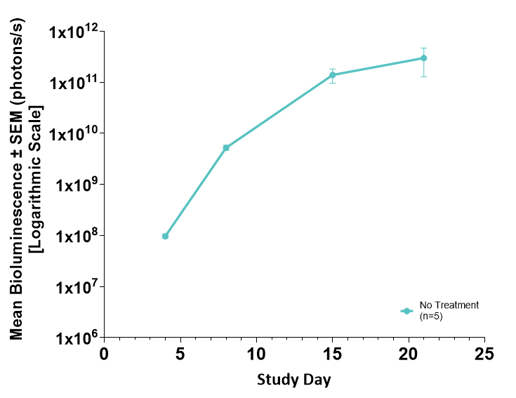
Mean BLI Signal: Disseminated NALM6-Fluc-GFP Human ALL in Female CIEA NOG Mice
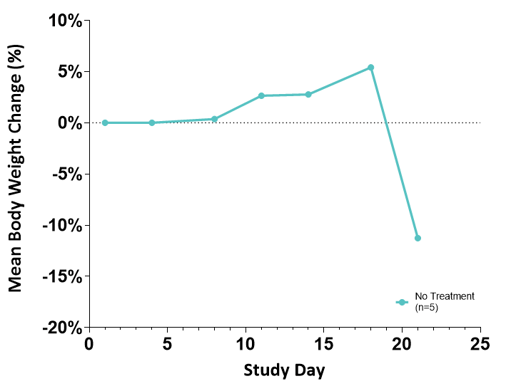 Mean Body Weight Change: Disseminated NALM6-Fluc-GFP Human ALL in Female CIEA NOG Mice
Raji-GFP-Luc: A Benchmark Model for B-cell Surface Antigen Targeted Therapies Against Burkitt’s Lymphoma
Raji is a human B-lymphocyte cell line isolated from the jaw of an 11-year-old male with Burkitt’s lymphoma. Because Raji cells reliably express high levels of key B-cell surface antigens, CD19, CD20, and CD22, CAR T-cells have multiple targets for tracking down malignant cells.
This model is especially useful since single target CAR T-cell therapy often fails when cancer cells downregulate a single antigen to evade immune detection, leading to relapse. By targeting multiple antigens simultaneously, the therapy ensures that even if a cancer cell downregulates one marker, CAR T-cells can still identify and eliminate it through the remaining targets. Consequently, Raji serves as an essential benchmark for evaluating both single- and multi-target CAR T-cell therapies.
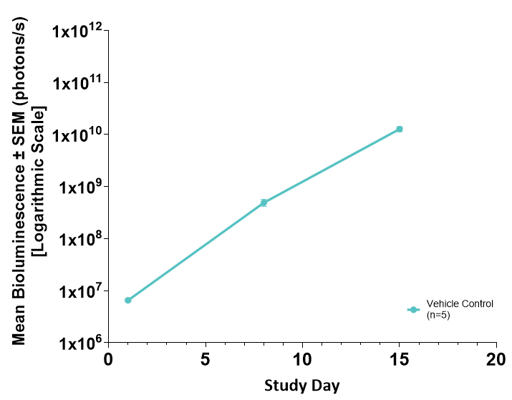
Mean BLI Signal: Disseminated Raji-GFP-Luc Human Burkitt’s Lymphoma in Female NSG Mice
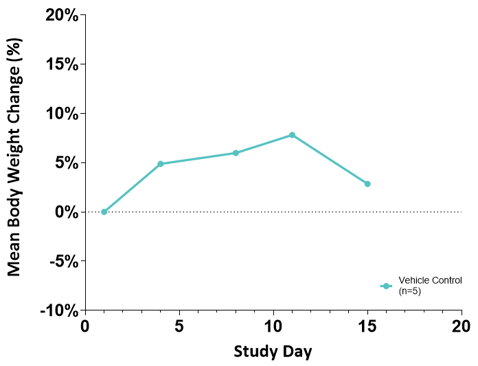
Mean Body Weight Change: Raji-GFP-Luc Human Burkitt’s Lymphoma in Female NSG Mice
MM.1S-Luc: A Benchmark Model for CS1 and BCMA Targeted Therapies Against Multiple Myeloma
MM.1S is a human multiple myeloma cell line derived from the peripheral blood of a 42-year-old female patient with IgA lambda myeloma. MM.1S cells reliably express high levels of BCMA and CS1 (SLAMF7). These two surface antigens are highly expressed on myeloma cells but minimally expressed on healthy tissues, minimizing off-tumor toxicity. Co-expression of these markers on MM.1S makes it an ideal model for testing single- and dual-targeted (BCMA/CS1) CAR T-cell strategies, which overcome tumor heterogeneity and prevent antigen escape.
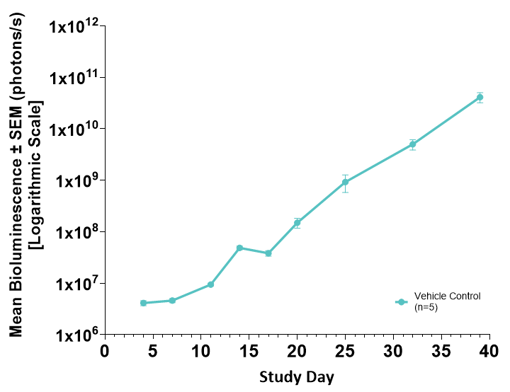
Mean BLI Signal: Disseminated MM.1S-Luc Human Multiple Myeloma in Female NSG Mice
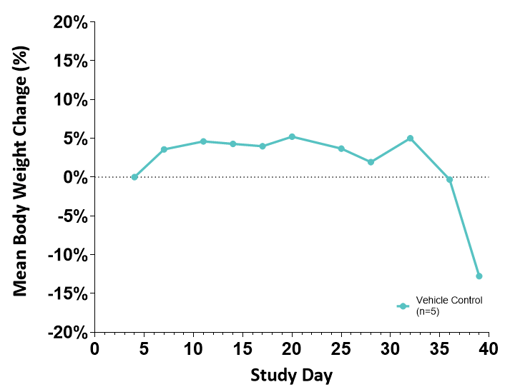
Mean Body Weight Change: Disseminated MM.1S-Luc Human Multiple Myeloma in Female NSG Mice
Future Directions
The future direction of CAR T-cell therapy is focused on decreasing the cost of manufacturing CAR T-cells and the ability to target more challenging cancers. Hematologic malignancies can serve as bridging studies to help answer these questions in a more cost-effective way. First, by evaluating allogeneic CAR T-cell therapies, not only for potency, but also the mitigation of Graft-versus-Host Disease. Second, by establishing core engineering principles in a more easily accessible blood-based environment. Research using multi-targeting strategies, CARs with chemokine receptors, matrix-degrading enzymes, armored CARs and TRUCKS (T cells redirected for universal cytokine killing) were first developed or inspired by research performed in hematological malignancies prior to further development to focus on solid tumors.