
Based on the American Cancer Society 2026 estimates and survival statistics, as of October 2026, developments in antibody-drug conjugates (ADCs), endocrine resistance, HER2-directed treatment, and biomarker-guided therapy have major impacts in both clinical treatment and preclinical research. This overview focuses on those implications, including preclinical model selection and research planning.
Incidence and Survival
321,910 new invasive cases estimated among US women in 2026.
42,140 deaths estimated among US women in 2026.
About 13% average lifetime risk among US women.
Over 90% overall five-year relative survival among women with invasive breast cancer, according to recent estimates.
FDA Treatment Updates in 2026
The following approvals affect treatment sequencing and the use of biomarkers in clinical development:
May 15: Earlier-stage HER2-positive disease
Enhertu (trastuzumab deruxtecan, T-DXd) was approved as part of a sequential neoadjuvant regimen for stage II–III HER2-positive breast cancer. It was also approved as adjuvant treatment for residual invasive disease after specified neoadjuvant therapy.
June 24: First-line TNBC treatment
The FDA approved Trodelvy (sacituzumab govitecan) for first-line treatment of unresectable locally advanced or metastatic TNBC in patients who are ineligible for PD-1/PD-L1 therapy.
September 4: ESR1-guided treatment
Camizestrant received accelerated FDA approval with a CDK4/6 inhibitor for HR-positive/HER2-negative advanced or metastatic disease when an ESR1 mutation emerges during aromatase inhibitor plus CDK4/6 inhibitor therapy.
September 18: Oral SERD combination
Imlunestrant plus abemaciclib was approved for ESR1-mutated HR-positive/HER2-negative advanced or metastatic disease after progression on at least one line of endocrine therapy.
October 7: HER2-positive maintenance therapy
Tucatinib received approval with trastuzumab and pertuzumab as maintenance therapy after initial treatment for unresectable locally advanced or metastatic HER2-positive disease.
How TD2 Supports Breast Cancer Research
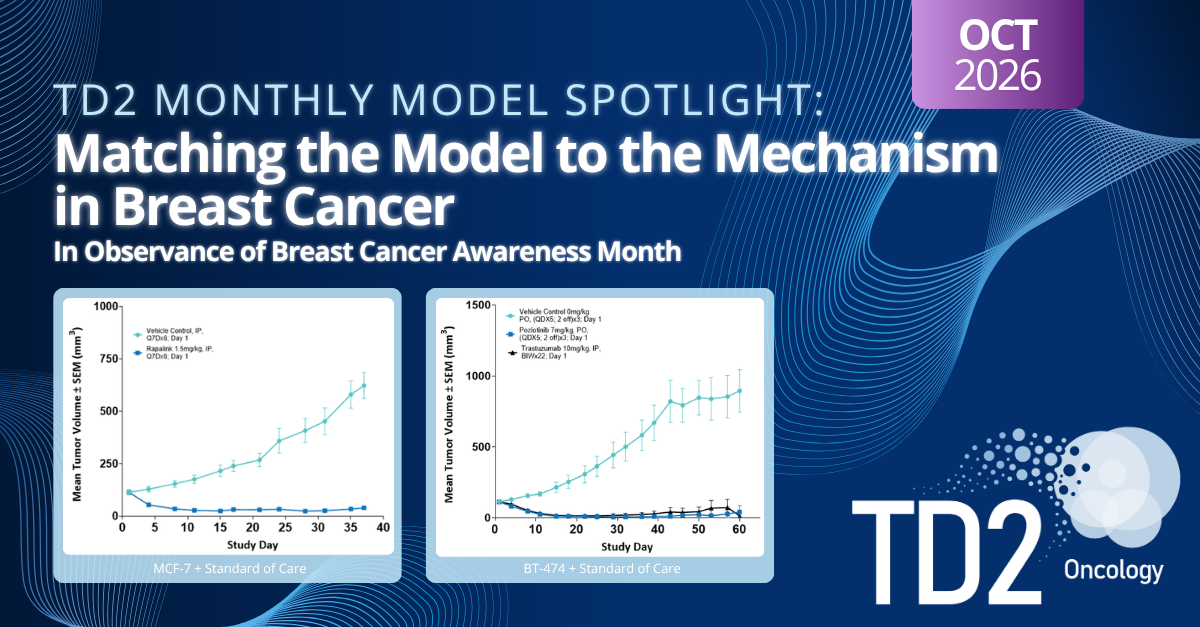
TD2 offers a portfolio of more than 40 breast cancer models across human cell lines, syngeneic models, and patient-derived xenografts (PDX). The appropriate model depends on the scientific question, therapeutic mechanism, and intended application. Examples from the TD2 portfolio include:
| Clinical classification | Major characteristics | TD2 Translatable Preclinical Models | Research goal |
|---|---|---|---|
| HR-positive / HER2-negative | ER and/or PR positive (70% of all cases) | MCF-7, ZR-75-1 | Endocrine resistance in ER+ disease |
| HER2-positive | Overexpression of HER2 | BT-474, HCC1954 | HER2-targeted therapies and ADCs |
| Triple-negative (TNBC) | ER−, PR−, HER2− | MDA-MB-231, MDA-MB-468 | TROP2-targeted ADCs |
Model selection should be supported by appropriate characterization. Receptor status, target expression, genotype, and other relevant biological features can influence how well a model addresses the intended research question.
From Model Selection to Actionable Data
A well-designed preclinical study begins with a clear hypothesis. TD2 works with research teams to align the experimental approach with the biological question and therapeutic mechanism. Depending on program objectives, this may include:
Model and biomarker characterization: Evaluating relevant receptor profiles, target expression, and molecular features to support model selection.
In vitro pharmacology: Investigating drug activity and sensitivity in models selected for the therapeutic hypothesis.
In vivo efficacy studies: Evaluating antitumor activity using appropriate xenograft, syngeneic, or PDX models.
Mechanism-informed study design: Incorporating relevant characterization and endpoints to help interpret observed responses and investigate potential sources of variability.
For ADC programs, for example, target expression is an important part of model selection, but it is not the only determinant of response. Internalization, payload sensitivity, drug efflux, and other resistance mechanisms may also influence activity. A study designed around these factors can provide a more informative assessment than one based on target expression alone.
A Scientific Partner for the Next Stage of Breast Cancer Drug Development
As breast cancer treatment becomes more biomarker-driven, preclinical research must do more than generate tumor growth curves. It must help researchers understand the biology behind the results and determine which questions should be addressed next. TD2 combines a diverse breast cancer model portfolio with scientific collaboration and preclinical pharmacology to support oncology drug development teams.
Have a breast cancer target, therapeutic candidate, or resistance mechanism to investigate? TD2 can work with your team to identify relevant models and develop a study strategy aligned with your program objectives.